-

News &
events
27.09.2018
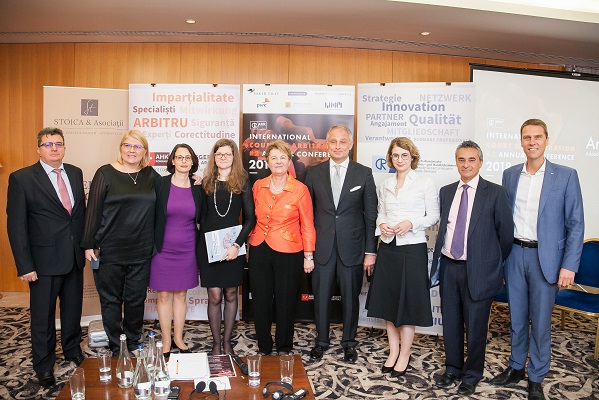
The lawyers from STOICA & ASOCIAȚII - in the panel of the Annual Conference of the Permanent Court of International Arbitration attached to AHK Romania
The Romanian-German Chamber of Commerce and Industry (AHK Romania) organized the second edition of the Annual Conference of the Permanent Court of International Arbitration attached to AHK Romania on September 27, 2018 at the Crowne Plaza Bucharest Hotel, with the theme "Arbitration: Added Value to Dispute Resolution".
The conference is an initiative launched by the Permanent Court of International Arbitration of AHK Romania in 2017, with the theme "How to Build Trust in Institutional Arbitration", and the success achieved encouraged the organizers to continue this project.
This year's conference - moderated by Professor Claus Köhler, PhD (President of AHK Romania) - brought together professionals from the international arbitration world who presented both the theoretical and practical aspects of the arbitration procedure. Thus, Amy Kläsener (Dentons, Frankfurt) and Cristiana I. Stoica, PhD / Andreea Micu (STOICA & ASOCIAȚII, Bucharest), presented the theme "Party Autonomy in International Arbitration"; Gertraud Bauer, PhD (Baker Tilly, München) and Professor Claus Köhler, PhD (Meister Rechtsanwälte, Munich) spoke on the "Emergency Arbitrator / Interim Measures"; Christina Alexe, PhD (ACEADVISOR, Bucharest) and Nikolaus Vavrovsky, PhD (Vavrovsky Heine Marth, Vienna) had the theme "Ethical Rules, Best Practice and Consequences of Non- Compliance" and Sirshar Qureshi (PwC CEE, Praga) and Florin Niculescu (FIDIC-Expert, Bucharest) held a presentation with the topic „Evidence in Arbitration as an “Asset” of Decision Making”.
Dr. Cristiana I. Stoica - Founding Partner and Andreea Micu - Partner, STOICA & ASOCIAȚII, presented and discussed the theoretical and practical implications of the parties’ autonomy of will from the perspective of the arbitration agreement and, respectively, the content and limitations of this freedom. The speakers agreed that the autonomy of the parties' will is a guiding principle in arbitration proceedings. Although the freedom of the parties to establish the general framework of the arbitration procedure prevails, this freedom is not absolute. In this respect, a number of concrete examples have been offered, through a comparative analysis of the Arbitration Rules of the Paris International Court of Arbitration (ICC Paris), of those elaborated under the aegis of the Court of International Commercial Arbitration attached to the Chamber of Commerce and Industry of Romania (CICA-CCIR) and the rules developed under the aegis of the Romanian-German Chamber of Commerce and Industry (AHK Romania). At the same time, comparative clarifications were made regarding the existing rules at the level of the Romanian procedural law, as well as at the international level (UNICITRAL rules).
The conclusion was that, by choosing the arbitration institution, the parties implicitly agree to be subject to certain rules that will determine the scope of the applicable procedural rights and obligations. Thus, with the choice of the arbitration institution designated to resolve the dispute, the parties' freedom of will is both modulated by compliance with mandatory rules and public order as well as with institutional rules.
LATEST NEWS
Legal news analyzed by STOICA & ASOCIAȚII’s lawyers