-

News &
events
11.12.2023
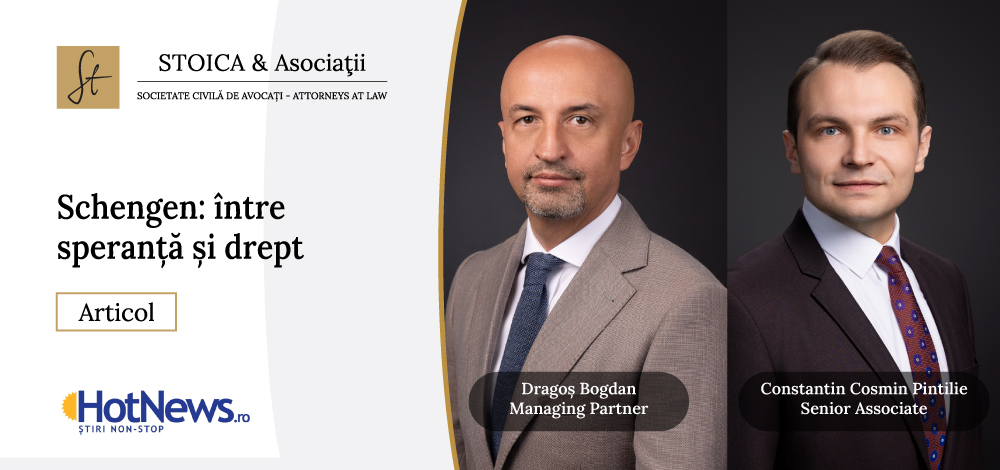
Schengen: between hope and law
Although the"Schengen topic" has been in the headlines in the media lately, I have noticed that, in general, it is reported rather from a political perspective, without an in-depth analysis from a legal perspective. However, as the Court of Justice of the European Union ('the Court') established in a recent decision, the existence of a political element does not mean the removal of any jurisdictional control, and therefore of the legal aspect of the situation. This is only to be expected: in a state governed by the rule of law, the political is normally clothed in legal garb, and the legal - understood here as a body of legislation - is based on decisions that are ultimately political.
In this article, we aim to offer a legal perspective on the issue. We do not claim to be exhaustive - the subject is so complex and controversial that we doubt that it can be analyzed from all angles, even in much more substantial articles than this one -, especially as we wish to avoid an overly technical exposition of the subject.
The story is well known: a year ago, in December 2022, the EU Council did not adopt, in the absence of unanimity, a draft decision that, from a legal point of view, would have led to the full application of the Schengen acquis in Romania. From a practical point of view, this would have meant lifting controls at the EU's internal borders shared with Romania.
At the same meeting, however, the Council managed to adopt the decision for the full application of the Schengen acquis in Croatia. Although the European institution found as long ago as 2011 that Romania meets all the necessary standards to join the Schengen area, it is not known at this stage whether internal border controls will ever be lifted. The Commission and the EU Parliament have repeatedly called on the Council to lift internal border controls for Romania and Bulgaria. While for a long time the pretext for maintaining the control was the existence of the Cooperation and Verification Mechanism (CVM), even though the provisions of the Treaties did not in any way link the two issues (i.e. the CVM and Schengen accession), with the formal abolition of the CVM on September 15, 2023, the only logic left to Austria's disposal is that of exercising arbitrary power: "I oppose because I can and because I want to". By voting in favor of Croatia, it is obvious that the reason given by Austria, that the Schengen area "does not work" and that it needs to be reformed before being enlarged, is just a pretext.
But the logic in which the European Union operates is not arbitrary. The European Union is not just an economic and political construction, but a union created and developed by law - a union based on therule of law. Romania's Act of Accession to the European Union stipulates that the entire Schengen acquis is binding on the Romanian state from the moment of accession, but the lifting of internal controls can only be carried out on the basis of a unanimous decision adopted by the Council. However, the unanimity required in the Council - which enshrines the political nature of the decision - is only part of the legal reasoning.
From a legal perspective, the Schengen area today is a form of enhanced cooperation, i.e. a kind of smaller "union" operating within the Union, applying EU rules, principles and using EU institutions. This formula allows the Union's objectives to be developed, even when not all Member States have wanted to participate in closer integration in a particular area. According to the EU Treaties, forms of enhanced cooperation must remain open to the participation of all Member States. Through the Act of Accession, both Romania and Austria - as well as all other Member States participating in Schengen - agreed that Romania not only has the right, but even the obligation to become an integral part of the Schengen mechanism. According to the EU Treaties and Romania's Act of Accession, the question is not "if" Romania will join Schengen, but "when".
However, last year's Council decision transforms this "when" into an "if", by making full accession dependent on the discretionary will of any participating Member State. It could be said that any Member State could have expressed its opposition at the time of Romania's accession (and the insertion of the clause in the Act of Accession), or at the time of the integration of the Schengen acquis into the EU Treaties; since this did not happen, those states no longer enjoy absolute, unchallenged sovereignty to decide in any way - even discretionary, arbitrary or discriminatory - on the enlargement of the Schengen area. It must be emphasized that there was no reservation on the part of Austria, or any other Member State participating in Schengen at that time, and reasons relating to a State's domestic policy cannot be invoked, in principle and without any judicial review, to prevent that State from fulfilling the obligations it has assumed under the international treaties or EU Treaties to which it is a party.
It is true that Romania's Act of Accession does not impose a deadline within which the Council must adopt the decision that would lead to the lifting of internal border controls. However, the absence of a deadline does not mean that this EU institution can postpone the full application of the Schengen acquis indefinitely, but that the Council decision must be adopted as soon as the technical conditions have been met. The Council itself took this approach in 2011, when it found that the technical requirements were met and the relevant decision had to be taken no later than the end of that year. 12 years later, the situation has not changed significantly.
In addition, the decision to lift internal border controls has to be taken within the institutional framework of the Union. In other words, it is the Council that has the power to take the decision, not the Member States, outside the Union's mechanisms. This nuance is important from a legal point of view, because the Council is the institution responsible for the failure to perpetually postpone the lifting of internal border controls with Romania and Bulgaria.
This failure has very important consequences for the citizens of the Union. If the attention is focused solely on the rule in the Act of Accession which requires unanimity, the risk of missing the heart of the matter is very high. The freedom to move within a border-free area at internal borders is not just an objective of the Union, but a right recognized by the EU Treaties for European citizens, including Romanians. In this context, it would be superfluous to list all the surprisingly numerous rules in the Treaties which explicitly enshrine this right, as well as the Union's objective of creating an area without internal border controls. By way of example, Article 67(2) of the Treaty states that (2) TFEU unequivocally lays down that the Union is obliged to ensure the absence of checks on persons at internal borders.
Legally speaking, the maintenance of internal border controls is nothing other than a form of restriction of freedom of movement. As EU citizens, Romanian citizens enjoy the fundamental right to move without being subject to controls when crossing internal EU borders, when they are already in the Schengen area. Controls at Romania's border, which is also the EU's internal border, do not lead to the disappearance of this right, but are a form of interference, a restriction on its exercise. Fundamental rights allow restrictions, but not under all conditions. They would lose their essential characteristic - that of being fundamental - if they could be restricted at any time and in any way. What is the legitimate aim of maintaining internal border controls? Is it justified? Is it proportionate? Is there a clear time limit against making the restriction permanent?
Neither the Council nor Austria has been able to provide coherent answers to these questions. At present, the Union has failed to ensure respect for the rights recognized by the Treaties, not to mention the fact that the way in which Austria has acted is in clear contradiction with the principle of loyal cooperation and the principle of mutual trust, principles which Member States are obliged to respect.
When the Treaties make it very clear that the lifting of internal border controls is a principal objective of the Union, objectives which the Member States have expressly undertaken, and when Austria cannot provide the slightest reasonable and objective justification for the way in which it has acted in Romania's situation, it is obvious that the problem is not just political, but of a genuine legal nature. The clear intention at the time of concluding the Act of Accession was that Romania should become a full part of the Schengen mechanism, in accordance with the objectives set out in the Treaties. By ratifying these treaties, Austria itself limited its own power and cannot oppose in a purely arbitrary manner the lifting of internal border controls.
All these questions are currently before the Court, as several legal actions have been brought against the Council's position adopted at its December 2022 meeting. In this context, the Court will decide whether all that matters is unanimity in the Council and any Member State can in an eminently arbitrary manner maintain a restriction of fundamental rights, or, if in this case, it is more than that. The arguments and counter-arguments of a legal nature are much more numerous than those very briefly set out above, and we believe that they will be weighed very carefully by the Court of Justice of the European Union, in a case that may prove important also from the wider perspective of the functioning of the Union's institutions.
Essentially, the Court will have to decide "when" hope turns into law, or "if" law was, in fact, a mere hope.
An article signed by Dragoș Bogdan, Managing Partner - dbogdan@stoica-asociatii.ro and Constantin Cosmin Pintilie, Senior Associate - cpintilie@stoica-asociatii.ro - STOICA & Asociații
LATEST NEWS
Legal news analyzed by STOICA & ASOCIAȚII’s lawyers